

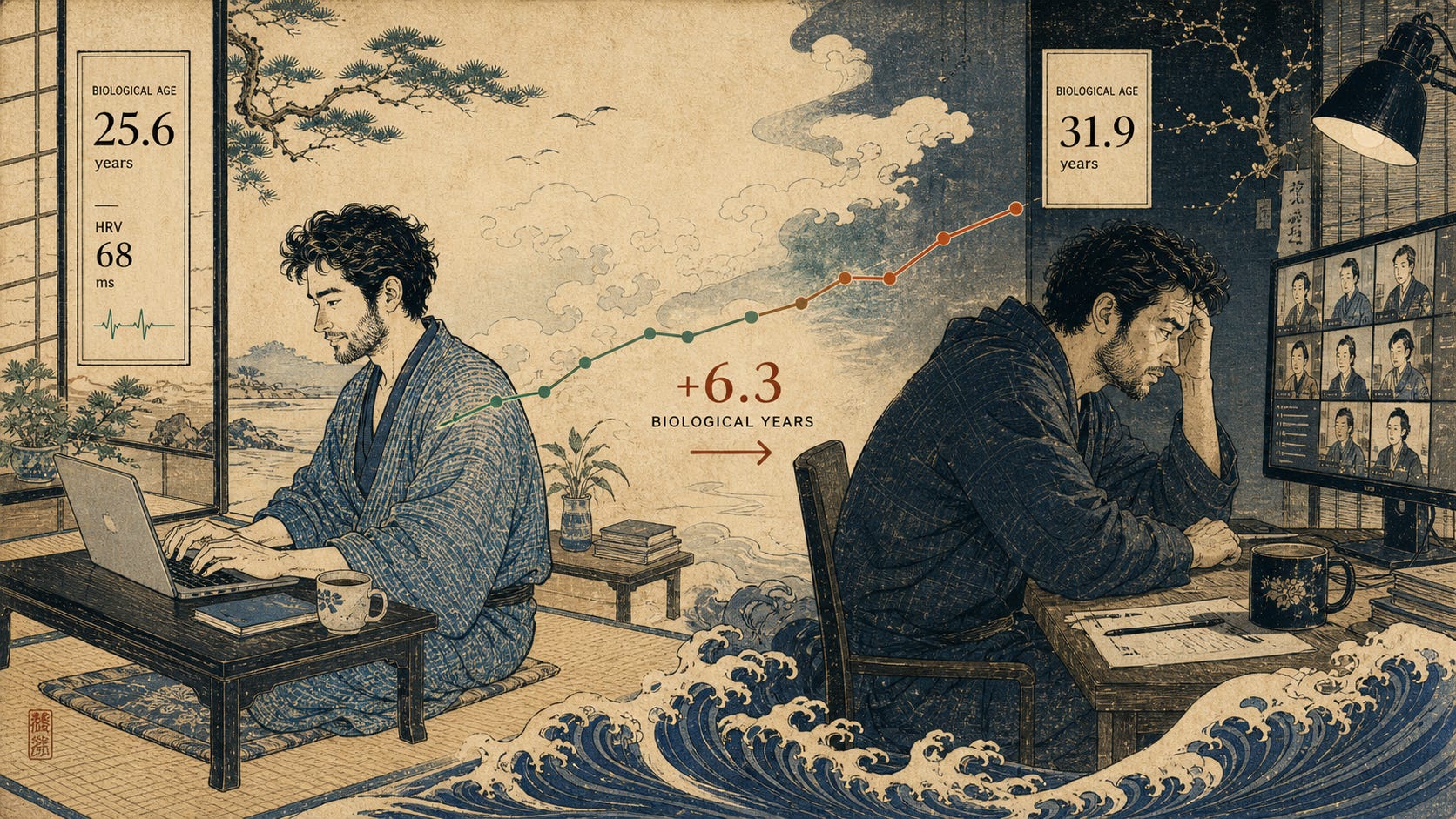
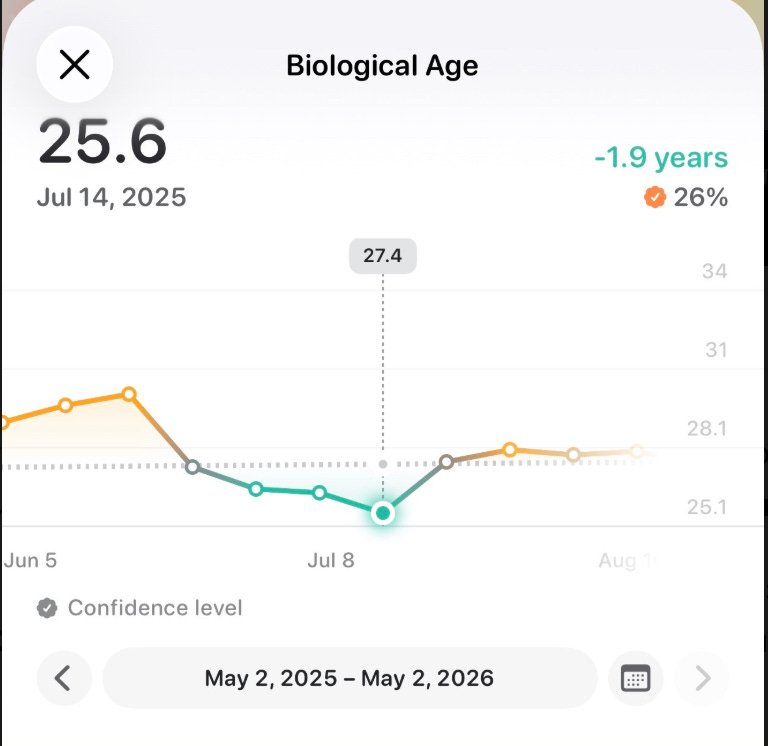
In July 2025 I got fired. I track my biological age through an Apple Watch app called Bevel. A couple weeks after losing my job, my bio age read 25.6. I was 27. My body was almost two years younger than my passport.
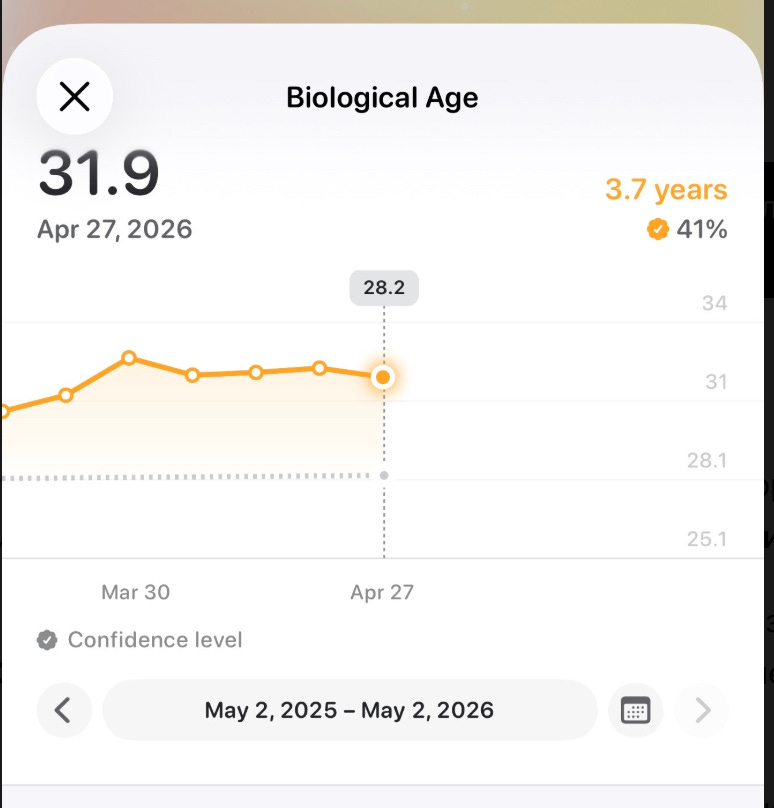
It’s April 2026 now. I’m back in a salaried position. Same tracker reads 31.9. I’m 28.
The difference between “I got fired” and “I’m employed again” was 6.3 biological years in nine months.
I read that number three times. Googled whether the app was bugging out. Pulled up the trend for the past year and a half. A bug would be noise. This was a clean line down when I was free and a clean line up when I was back at a desk.
And no, I wasn’t on a couch those months. I was writing code for my own app. Cooking meals. Walking. Living with my girlfriend and our cat. I was working. Just on my own terms.
The problem isn’t workload
The first thought that pops up is obvious. Work equals stress, stress ages you. Cool, thanks.
But here’s the thing. When I was building my product after getting fired, I was stressed too. Money was running out. I had no idea if any of it would work. I coded evenings and weekends. In terms of hours and anxiety, there was no difference.
The difference was one thing. I chose what to do. I picked the tasks. I could stand up, walk to the kitchen, think, come back, and do it differently. Nobody set my OKRs. Nobody pulled me into a call where ten people discuss a button color for forty minutes.
There’s a Finnish study, Northern Finland Birth Cohort 1966, 604 people. They measured epigenetic clocks, which is a more precise way to read biological age through DNA. They found something interesting. People with high workload AND high control over their work aged about 1.5 years slower. People who feared losing their job aged about 2 years faster.
Let me translate that. Hard work where you decide what and how to do things makes you younger. Hard work where someone else decides for you kills you. The difference isn’t volume. It’s control.
In occupational psychology there’s a model called effort-reward imbalance by Siegrist. You put in effort, but the reward doesn’t match. Not just money. Recognition, meaning, growth, impact on the outcome. When that balance is broken long enough, the body starts paying. Elevated cortisol, chronic inflammation, allostatic load. That last one means your system has been in “danger” mode so long it forgot how to switch off.
A study called ELSA tracked 2,663 people over time and found that repeated effort-reward imbalance was linked to higher allostatic load index. In plain words: your body keeps score. When you spend your best hours for years on things you don’t care about for a paycheck that’s just “fine,” your body writes that down. Not metaphorically. In your cells.
What I saw when I looked at my life through this lens
I’m 28. Six-figure salary in tech. Sounds good on paper.
Let’s count differently.
In 9 months of employment my body aged 6 years compared to the period without a job. If the current trend continues, by the time I’m 48 my biological age will be 54.
Six figures a year. Six years of life in nine months. What’s the ROI on that?
I’m not saying the salary is bad. I’m saying the price I pay for it is invisible. It’s not on my bank statement. It’s in the data from my watch. In how I wake up. In the fact that my neck has been hurting for three weeks and my manual therapist found thoracic scoliosis getting worse while I sit hunched over on Zoom calls.
The trap everyone sits in
You know what’s the worst part? I understand all of this. I see the numbers. I read the studies. I know I need an exit. And every morning I open my laptop and join the standup.
Because I have debt payments every month. Because I’m relocating to a new country in two months. Because my visa is tied to my employer. Because “I’ll hold on a bit longer, and then...”
Then never comes. Then always moves. First “let me pass probation.” Then “let me get the visa.” Then “let me build a safety net.” Then “let me polish the product.” And so on until the tracker shows 40 at age 30.
I’m not writing this to complain. I’m writing because I’m pretty sure half of you are in the same trap. You just don’t have a tracker that shows you the price.
What I’m doing about it
I don’t have a pretty ending in three bullet points. I have a plan and it’s boring.
I build a product in the evenings. A personal finance app that works without cloud and doesn’t hand your data to banks. That’s my small boat. The salaried job is the tanker I’m riding until the boat is ready.
Every hour I spend on my product is an hour in high-control mode. That’s literally medicine. The body doesn’t distinguish between “work” and “hobby.” It distinguishes between “I decide” and “someone decides for me.”
At the same time I’ve dialed the day job down to the minimum. Not out of laziness. Out of math. Every extra hour in “doing meaningless stuff for someone else’s KPI” mode costs me biological time. I do exactly enough to not get fired before the move.
And I move. Physically. Because that’s the only way to lower allostatic load while you’re inside the system that generates it. Thirty minutes of zone 2 cardio brings cortisol down, improves heart rate variability, and tells the body “we’re safe.” My HRV right now is 44. Should be 55 to 70 for my age. Room to grow.
Why I’m writing this
Because nobody shows the other side of a “good tech job.” Everyone sees the salary. Nobody sees what the body pays for it.
When I got fired, I was scared. A month later I was healthier than I’d been in three years. That’s not normal. Getting fired shouldn’t be a health procedure. But for me it was.
If you’re reading this and you see yourself, I won’t tell you to quit everything and follow your dream. That’s dumb advice for people without bills. I’ll say something else.
Look at your data. Not mine. Yours. Measure your HRV on a workday morning and on a Saturday morning. Compare. Look at your sleep quality. How often you get sick. How often your back hurts, your neck, your head.
Your body doesn’t lie. It has no reason to. It just counts.
And then decide for yourself. But at least decide knowing the price.
I write about autonomy, health, and building products. If that’s interesting, subscribe. I promise not to send you marketing garbage.